Turning A PDF Into A Real EPUB
Going from fixed pages to reflowable text means guessing at something the PDF never recorded, and packing the result in a way strict readers will accept. Both parts are easy to get wrong and both are visible in the result.
Upload the PDF, optionally set a title and author, and download the EPUB.
Workflow Lifecycle & Pipeline
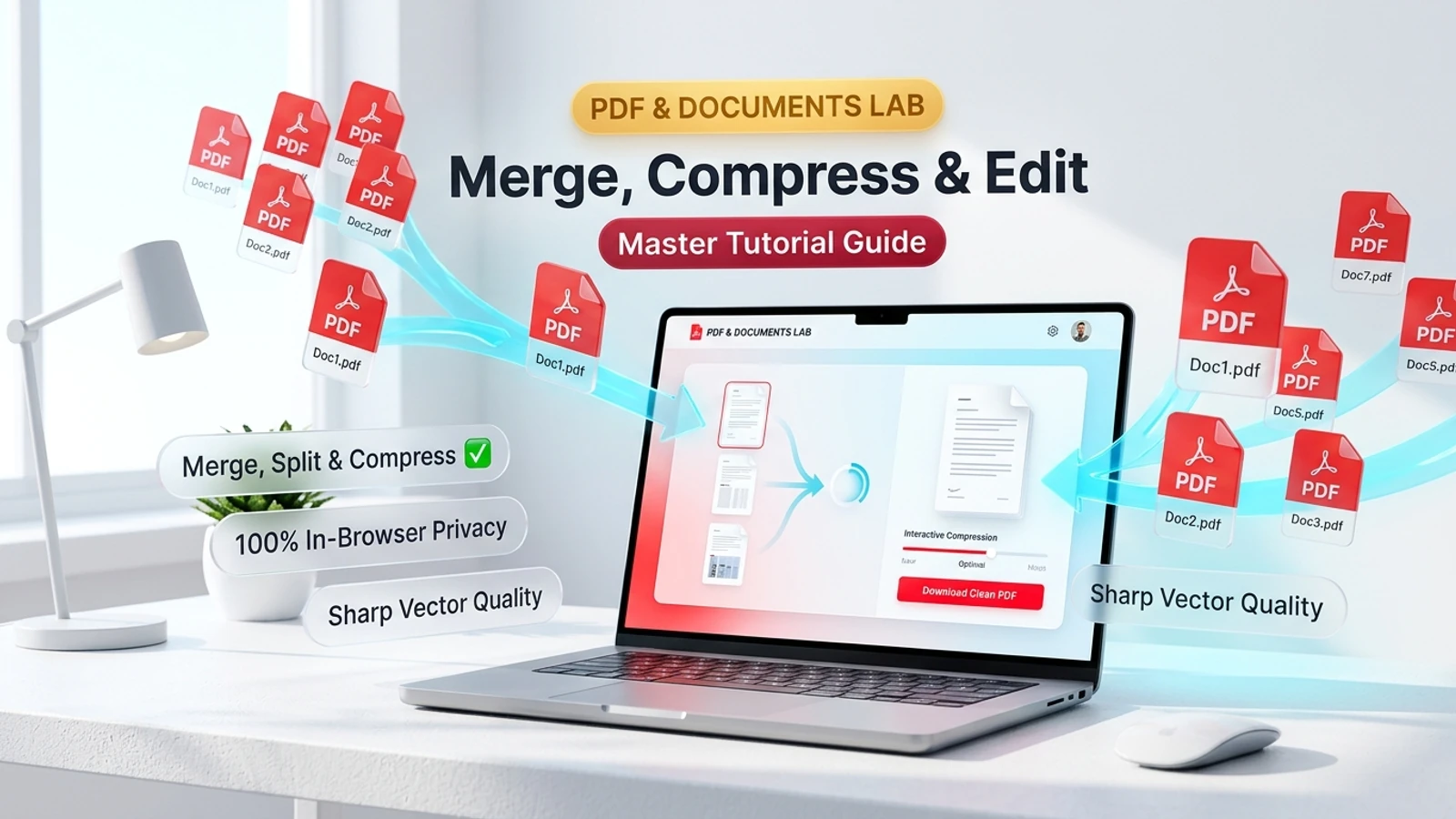
Visual execution flow showing how PDF to EPUB processes data directly in your local browser sandbox.
PDF to EPUB Interactive Process Pipeline
Fast, zero-latency execution directly in your browser memory.
Before You Start
Ensure your source assets and browser environment meet the verified execution requirements.
Step-by-Step Instructions
Follow these verified steps to execute the task with PDF to EPUB.
Add your PDF PDF
Open PDF to EPUB and drop your PDF onto the page, or pick it from the file dialog. It reads PDF, up to 100 MB each.
contract.pdfChoose your 4 settings
Book title takes text, Author takes text and Language code takes text. 1 more sit below. Leave them alone and PDF to EPUB uses en, and leaves Book title and Author blank.
Book title blank · Author blank · Language code enPress Convert to EPUB
Convert to EPUB starts the work in this tab. Nothing is uploaded, so how long it takes is down to your own device.
Convert to EPUBPDF to EPUB runs on your deviceDownload the EPUB
The result appears with a download button, as EPUB. It was made on your device, so nothing has to be cleaned up afterwards.
Under the Hood: Binary Stream Parsing & Cross-Reference Mapping
PDF operations run client-side using WebAssembly-compiled byte interpreters. Rather than re-rendering pages on a remote server, the engine parses internal trailer dictionaries, cross-reference (xref) offset tables, and FlateDecode object streams entirely within local JavaScript memory.
Object Stream De-duplication
Embedded fonts, vectors, and ICC color profiles are referenced without duplicating overhead across pages.
Zero Server Persistence
Sensitive contracts, invoices, and IDs remain strictly encrypted in local memory and are purged on tab close.
Linearized Fast Web View
Byte structures are optimized for immediate page-by-page streaming in modern PDF readers.
Settings & Options Explained
Fine-tune quality, format, and compression parameters for your exact workflow.
Settings & Configuration Guide
| Setting | Recommended Value | How It Works & Impact |
|---|---|---|
| Book title | Leave it blank unless you need it | Left blank, the file name is used. Takes text. Impact: Read as written, so stray spaces and characters count. |
| Author | Leave it blank unless you need it | Takes text. Impact: Read as written, so stray spaces and characters count. |
| Language code | en | en, hi, ta — readers use it for hyphenation. Takes text. Impact: Read as written, so stray spaces and characters count. |
| Split into sections every | 0 | 0 keeps it as one continuous section, which is usually what you want. Takes a number from 0 to 200. Impact: The control runs from 0 to 200; 200 is as far as it goes. |
Best Practices & Key Considerations
Avoid common quality pitfalls and maximize output performance.
Expert Recommendations
- A PDF has no paragraph marks at all — only lines at positions. So paragraphs are inferred: a line ending mid-sentence joins the next, a full stop closes one, and a hyphen at a line end is treated as a word the layout broke. That inference is the single judgement in the conversion, and it is wrong wherever line breaks were meaningful: poetry, addresses, code listings.
- The mimetype file must be the FIRST entry in the archive and must be STORED rather than deflated. It is the one part of the EPUB container spec that a ZIP library gets wrong by default, and readers that check it reject the whole book. A file that is merely a ZIP of XHTML is not an EPUB.
- A scanned PDF has nothing to convert. If the pages are images of pages there is no text layer, and an EPUB is text — run OCR over it first and convert the result.
- Keep the stylesheet almost empty. Your reader's own font, size, margins and theme are the whole point of the format; a conversion that fixes the typeface hands you back a worse PDF.
- What is lost is the page design: columns, headers and footers, footnote positions, tables as grids, and images. What is gained is text that reflows, which is the only reason to do this at all.
Common Mistakes to Avoid
- Giving it a format it does not read — PDF are the ones it takes.
- Selecting several files at once; PDF to EPUB works on one per run.
- Expecting Split into sections every to go past 200 — 0 to 200 is the range the control offers.
- Waiting for an upload that never happens — PDF to EPUB runs in this tab, so the file stays on your device.
Troubleshooting & Fixes
Quick solutions for common browser constraints, format issues, and edge cases.
Troubleshooting & Common Issues
PDF to EPUB will not accept the file
Possible Cause: PDF to EPUB reads PDF and nothing else.
The page stops responding part-way through
Possible Cause: 100 MB is the ceiling, and the work runs on your own machine, so a file near that size is limited by the memory this tab is allowed.
Only one of several files comes back
Possible Cause: PDF to EPUB handles one file per run.
Split into sections every will not go above 200
Possible Cause: The control runs from 0 to 200.
Frequently Asked Questions
Everything you need to know about formats, privacy, and browser support.
Related Step-by-Step Guides
Explore companion workflows, optimization techniques, and verified tutorials.