
About Email Extractor — Free Online Tool
Email Extractor pulls addresses out of any pasted text, decodes the "name [at] example [dot] com" obfuscation, de-duplicates, and separates role addresses from people.
Uses the practical address pattern rather than RFC 5322, because the full grammar admits quoted local parts with spaces and would match ordinary punctuation. Reports domain counts and role addresses.
Addresses are matched out of the text in the page. Both the text and the addresses stay on the device.
Pulling addresses out of a document or email thread, de-duplicating a messy list, filtering to one domain, and separating shared inboxes from individuals.
Also known as: extract emails from text · email address finder · find email addresses · bulk email extractor
When to use it
Because addresses arrive buried in documents, threads and exported data, and because the obfuscations meant to defeat scrapers also defeat a plain copy and paste.
How it works
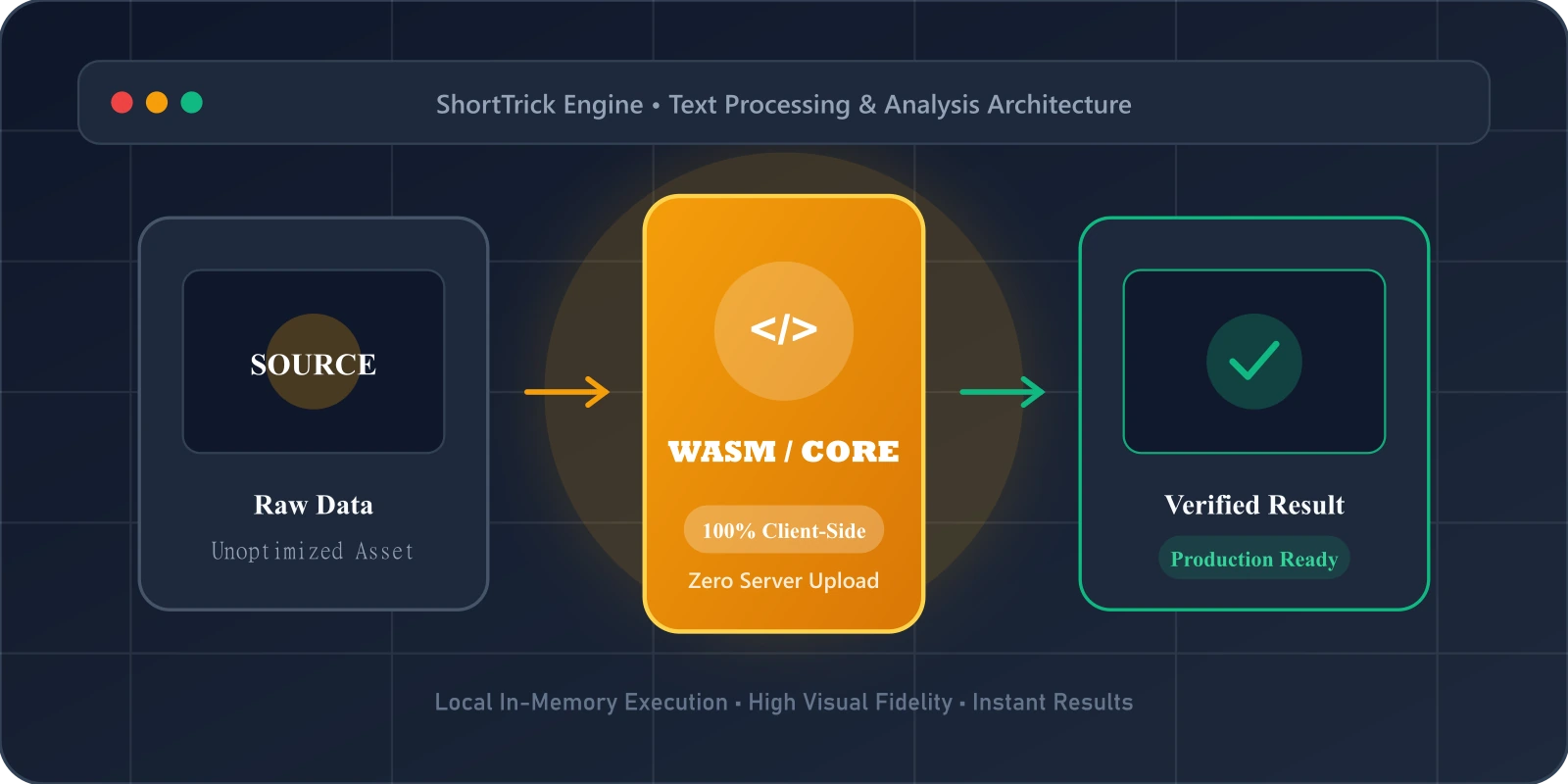
The text is normalised to undo the common obfuscations, scanned with a practical address pattern, then de-duplicated and filtered.
Why The Pattern Is Not RFC 5322
The real email grammar allows quoted local parts containing spaces, nested comments, and domain literals in square brackets. A regular expression that implements it is several thousand characters long, and the one thing it reliably does on real text is match ordinary punctuation. The pattern here is the practical subset: a local part of letters, digits and the usual separators, an @, and a dotted domain. It finds more real addresses and far fewer false ones, which is the trade that matters.
The Obfuscations Are Worth Decoding
"name [at] example [dot] com" exists to defeat scrapers, and it also defeats you when you want to write to the person. The square-bracket, round-bracket and brace forms are all decoded here, along with the spelled-out "at" and "dot". This is not about harvesting at scale — it is about a contact page you are actually reading being usable without manual retyping.
Role Addresses Are Not People
info, support, sales, contact, noreply, postmaster, abuse: these reach a shared inbox, a ticket system, or in some cases nothing at all. They are flagged separately and can be dropped, because a list that mixes them with individuals behaves differently — a role address is appropriate for a first enquiry and useless for a personal follow-up, and writing to noreply or postmaster as if they were people is how a message disappears.
Well-Formed Is Not Deliverable, And Found Is Not Consent
A well-formed address may never have existed. Only sending to it finds out, and sending to a scraped list is the fastest way to ruin a domain’s sending reputation — the bounces and spam complaints are what the receiving side measures. Separately: under the GDPR, the DPDP Act and most equivalents, an address published on a page is not consent to market to it. The penalties attach to the sending, not to the collecting, which is worth knowing before the list is used rather than after.
How to Use Email Extractor in 4 Easy Steps
Follow this simple guide to process your files in seconds directly inside your browser tab.
Paste or Type Your Text
Enter your text content into the Email Extractor workspace. A scanner that finds every email address in a block of text and gives you a clean, de-duplicated list in the separator you want.
Select Transformation Action
Choose the desired mode, delimiters, or transformation rules. Because addresses arrive buried in documents, threads and exported data, and because the obfuscations meant to defeat scrapers also defeat a plain copy and paste.
Instant String Processing
The client-side engine processes your content with Email Extractor immediately inside browser memory.
Copy or Export Result
Copy the updated text with one click or export it directly into your document or editor.
Why Use Email Extractor on ShortTrick
Engineered for maximum speed, strict privacy, and frictionless digital productivity.
Live Real-Time Analysis
Word counts, character stats, and transformations in Email Extractor update dynamically as you type.
Unicode & Multilingual Support
Email Extractor accurately handles words and characters across international alphabets, emojis, and symbols.
One-Click Clipboard Export
Cleanly copy transformed text or remove duplicate entries with a single click.
Private Draft Processing
Confidential manuscripts, emails, and articles stay strictly in local memory while using Email Extractor.
Frequently Asked Questions About Email Extractor
Common questions regarding Email Extractor, data privacy, file format compatibility, and usage limits.
Popular Searches & Related Tasks for Email Extractor
Common search phrases, secondary format tasks, and workflows users reach for when using this tool.
Direct Variations & Search Synonyms (8)
Specific Workflows & Long-Tail Queries (15)
Semantic Standards & Technical Entities (20)
Email Extractor compared with the closest alternatives
Only the specifications that actually differ between these 4 tools. Anything identical across all of them is left out rather than printed four times.
| Email Extractor | Text to Handwriting | Handwriting to Font Converter | Word Search Generator | |
|---|---|---|---|---|
| Accepts | TXT | TXT | PNG, JPG | TXT |
| Returns | TXT | SVG | TTF, PDF | TXT |
| Largest file | — | — | 25 MB | — |
Related Text & Content Tools & Popular Utilities
Explore complementary browser-based tools with zero file uploads and instant in-memory execution.
More Text & Content Tools
Popular Tools Across Other Categories
Related Reading & Tutorials
Guides, articles, and best practices for text & content workflows.
How to Extract Email Addresses from Text (Including Obfuscated Ones)

How to Make an Email QR Code With a Prefilled Subject

How to Use AI Email Writer Online: Step-by-Step Guide
How to Use Color Palette Extractor Online: Step-by-Step Guide
Why Your Email Signature Breaks In Outlook
