
How to Extract Email Addresses from Text (Including Obfuscated Ones)
Addresses arrive buried in documents, threads and exports, and the obfuscations meant to defeat scrapers also defeat copy and paste. A deliberately narrow pattern finds more real addresses than a strictly correct one.
Paste any text. You get a clean de-duplicated list, with role addresses flagged and an optional domain filter.
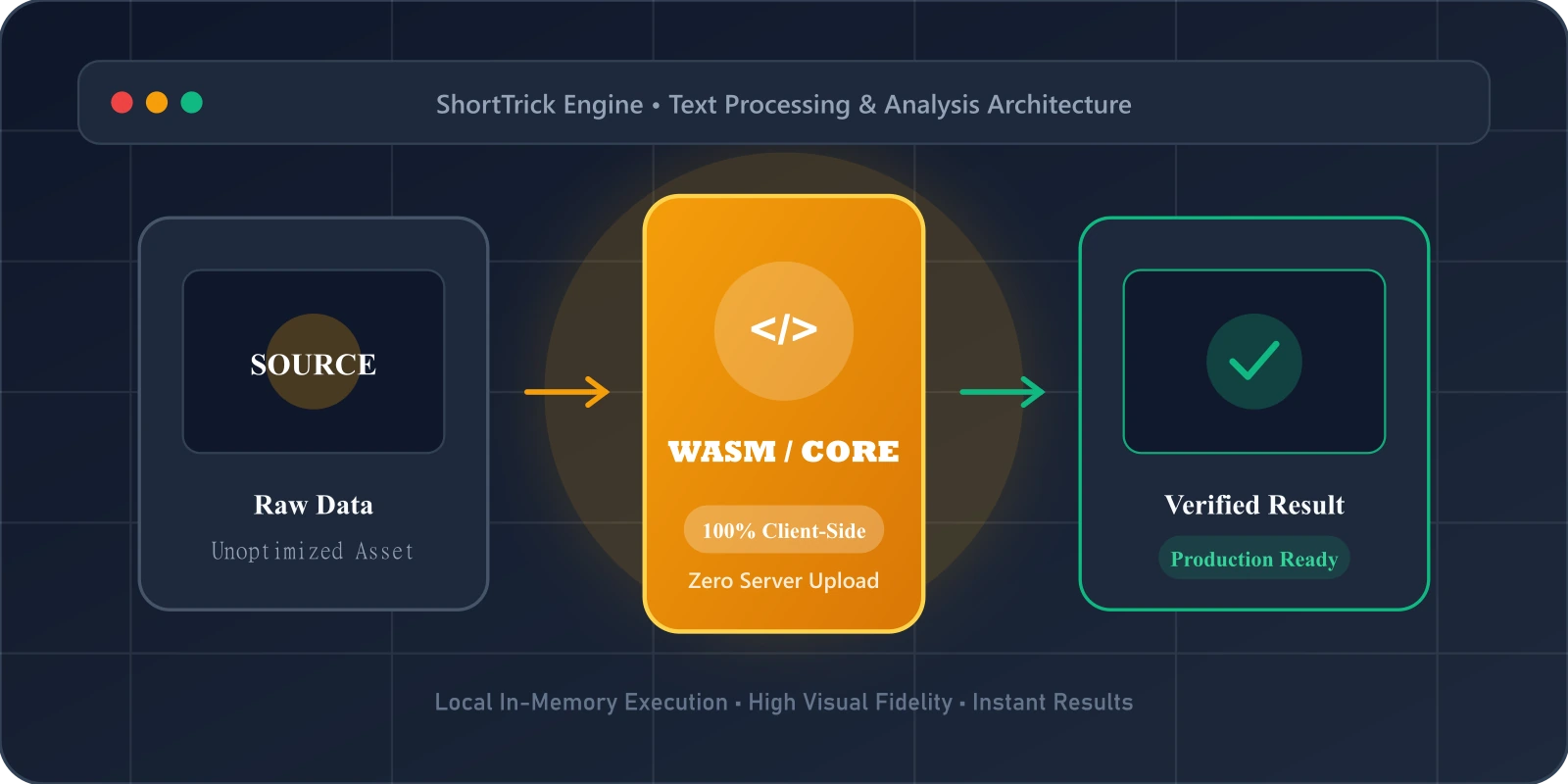
Workflow Lifecycle & Pipeline
Visual execution flow showing how Email Extractor processes data directly in your local browser sandbox.
Email Extractor Interactive Process Pipeline
Fast, zero-latency execution directly in your browser memory.
Before You Start
Ensure your source assets and browser environment meet the verified execution requirements.
Step-by-Step Instructions
Follow these verified steps to execute the task with Email Extractor.
Paste your text to scan
Type or paste into the text to scan box on the page. Email Extractor works on what is in it — there is no file to choose.
Paste a page, a document, a CSV, an email thread — anything with addresses in itText to scan read as you typeChoose your 7 settings
Read "name [at] example [dot] com" as an address takes on or off, Remove duplicates takes on or off and Lower case everything takes on or off. 4 more sit below. Leave them alone and Email Extractor uses on, on and on.
Read "name [at] example [dot] com" as an address on · Remove duplicates on · Lower case everything onWatch the result change
There is no button on Email Extractor: the result follows the input as you change it.
Updates as you typeEmail Extractor runs on your deviceCopy the answer
The answer sits at the top of the result panel with a copy button beside it. It never left your browser.
Copy the figureOn your clipboardUnder the Hood: In-Browser Algorithmic Computation
Every operation in this utility executes locally in your browser session using high-speed algorithmic transformations. Data inputs are immediately processed in volatile client memory and rendered to screen in sub-millisecond execution cycles.
Immediate Real-Time Computation
Zero server roundtrips guarantee sub-millisecond responsiveness with instant feedback.
Full Data Sovereignty
Your proprietary inputs, calculations, and conversions never travel across public networks.
Offline Capable Execution
Once loaded, the engine works seamlessly even during complete network disconnections.
Settings & Options Explained
Fine-tune quality, format, and compression parameters for your exact workflow.
Settings & Configuration Guide
| Setting | Recommended Value | How It Works & Impact |
|---|---|---|
| Read "name [at] example [dot] com" as an address | on | Takes on or off. Impact: Left on, which is what the tool does when you change nothing. |
| Remove duplicates | on | Takes on or off. Impact: Left on, which is what the tool does when you change nothing. |
| Lower case everything | on | Takes on or off. Impact: Left on, which is what the tool does when you change nothing. |
| Sort alphabetically | off | Takes on or off. Impact: Left off, which is what the tool does when you change nothing. |
| Drop role addresses (info, support, noreply…) | off | Takes on or off. Impact: Left off, which is what the tool does when you change nothing. |
| Keep only this domain | Leave it blank unless you need it | Leave empty for all. "example.com" keeps subdomains of it too. Takes text. Impact: Read as written, so stray spaces and characters count. |
Best Practices & Key Considerations
Avoid common quality pitfalls and maximize output performance.
Expert Recommendations
- The real RFC 5322 grammar allows quoted local parts with spaces and nested comments. A regex implementing it is thousands of characters and reliably matches ordinary punctuation in prose — the practical subset finds more real addresses and far fewer false ones.
- The [at] / (at) / {at} obfuscations are all decoded, along with the spelled-out words. It is on by default, which is what makes a contact page usable without retyping.
- Role addresses — info, support, noreply, postmaster, abuse — reach a shared inbox or nothing at all. They are flagged separately, because writing to noreply as if it were a person is how a message disappears.
- A well-formed address may never have existed. Only sending finds out, and sending to a scraped list is the fastest way to ruin a domain's sending reputation.
- Under the GDPR, the DPDP Act and most equivalents, an address published on a page is not consent to market to it — and the penalties attach to the sending, not the collecting.
Common Mistakes to Avoid
- Leaving Separate the output with on One per line when Commas or Semicolons was wanted.
- Not noticing that Read "name [at] example [dot] com" as an address starts on.
- Assuming the input is sent somewhere — Email Extractor runs in this tab, and nothing you enter leaves it.
Troubleshooting & Fixes
Quick solutions for common browser constraints, format issues, and edge cases.
Troubleshooting & Common Issues
The answer is right but not in the form you wanted
Possible Cause: Separate the output with is set to One per line, and it decides that.
The result area stays empty
Possible Cause: Email Extractor has nothing to work on until the input is filled.
Frequently Asked Questions
Everything you need to know about formats, privacy, and browser support.
Related Step-by-Step Guides
Explore companion workflows, optimization techniques, and verified tutorials.