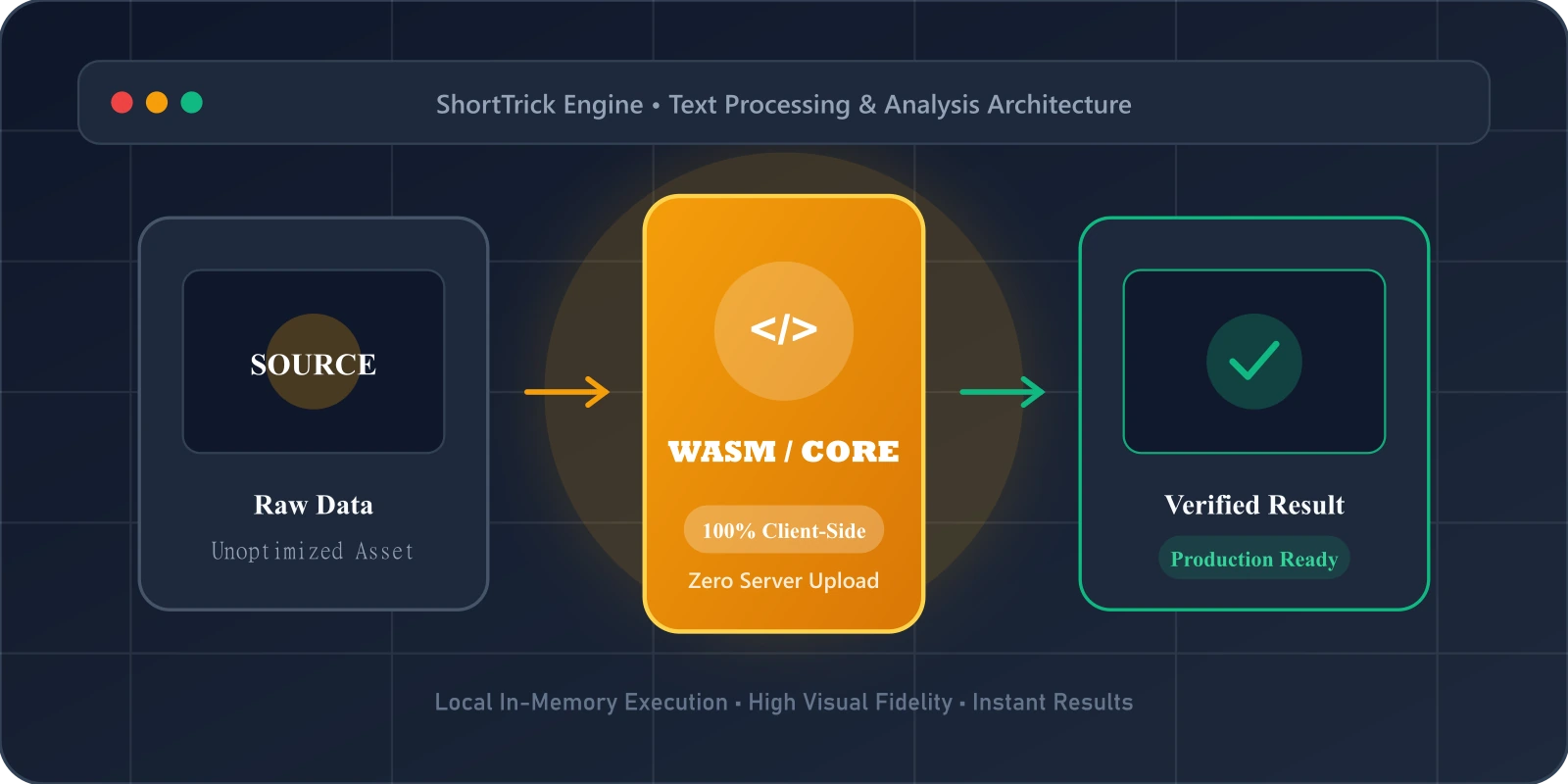
Ready to Execute
Click the blue ▶ Run button in the header bar or press Ctrl + Enter to compile and preview your results.
About Unicode Inspector — Free Online Tool
Unicode Inspector shows every codepoint in a string and flags the invisible characters and lookalike scripts that make text behave differently from how it reads.
Lists codepoints with UTF-16 unit counts, names eleven invisible characters explicitly, and detects Cyrillic, Greek, Armenian and fullwidth characters mixed into Latin text.
Inspected in this tab. Nothing is uploaded — which matters, since this is often used on text containing credentials.
Debugging a string that will not compare equal, finding a stray character in a pasted password, checking a suspicious domain or username, and diagnosing a failing validator.
Also known as: unicode character viewer · find invisible characters · zero width space detector · character analyzer · homoglyph detector · hidden character finder
When to use it
Because when two strings look identical and do not compare equal, the difference is always something you cannot see, and this is how you see it.
How it works
The string is split into codepoints and each is listed with its hexadecimal value. Known invisible characters are named, and non-Latin scripts mixed into Latin text are flagged.
The Invisible Characters That Break Things
A zero-width space pasted from a web page, a non-breaking space that looks exactly like a space but does not match one, a byte-order mark at the start of a file, a soft hyphen that only appears when a line wraps. Each is a real character that occupies a position in the string and fails every equality test while being completely invisible. This is the single most common cause of "but it looks the same" — and of a password copied from a password manager being rejected.
Lookalike Letters From Other Scripts
Cyrillic а, е, о, р, с and х are visually identical to their Latin counterparts in most fonts. So are several Greek letters. A domain or username built with one substituted letter is indistinguishable by eye and completely different as a string, which is the mechanism behind lookalike phishing domains. If text arrived from somewhere you do not control and this tool reports a non-Latin script mixed in, that is worth taking seriously.
Why Length Checks Disagree With What You See
One visible character can be several codepoints — an accented letter written as a base plus a combining mark, or an emoji built from several joined parts. And a codepoint outside the basic plane is two UTF-16 units. So a string can be "6 characters" by one count, "8" by another and "14 bytes" by a third, all correctly. All three figures are reported here so you can see which one a failing validator is using.
Right-To-Left Override
U+202E reverses the display order of everything after it. It has a legitimate use in bidirectional text and a well-known abusive one: a file named "report\u202Egnp.exe" displays as "reportexe.png" while remaining an executable. It is invisible, so the only way to see it is a tool like this one, and it is named explicitly when found.
How to Use Unicode Inspector in 4 Easy Steps
Follow this simple guide to process your files in seconds directly inside your browser tab.
Provide Input for Unicode Inspector
Paste your payload, code snippet, or string into the Unicode Inspector editor workspace. A character-by-character breakdown of a string, with its codepoints, byte length, and anything in it that is invisible or from an unexpected script.
Configure Formatting & Validation Rules
Select indentation preferences, minification, encoding options, or validation rules. Because when two strings look identical and do not compare equal, the difference is always something you cannot see, and this is how you see it.
Run In-Browser Engine
The engine executes Unicode Inspector locally in your browser with microsecond latency and zero server transmission.
Copy or Download Output
Copy the sanitized, formatted, or generated output directly to your clipboard or download it for your project.
Why Use Unicode Inspector on ShortTrick
Engineered for maximum speed, strict privacy, and frictionless digital productivity.
Zero Code or Token Leaks
Proprietary source code, API keys, database queries, and tokens processed in Unicode Inspector never leave your browser.
Microsecond Performance
Optimized AST parsers and Web Crypto APIs process large payloads in Unicode Inspector in milliseconds.
Syntax Validation & Formatting
Unicode Inspector highlights syntax errors and enforces standard formatting conventions automatically.
Offline Ready
Once loaded, Unicode Inspector functions entirely offline without requiring an active internet connection.
Frequently Asked Questions About Unicode Inspector
Common questions regarding Unicode Inspector, data privacy, file format compatibility, and usage limits.
Popular Searches & Related Tasks for Unicode Inspector
Common search phrases, secondary format tasks, and workflows users reach for when using this tool.
Direct Variations & Search Synonyms (8)
Specific Workflows & Long-Tail Queries (15)
Semantic Standards & Technical Entities (20)
Unicode Inspector compared with the closest alternatives
Only the specifications that actually differ between these 4 tools. Anything identical across all of them is left out rather than printed four times.
| Unicode Inspector | JSON Formatter & Beautifier | JSON Validator | JSON Minifier | |
|---|---|---|---|---|
| Accepts | TXT | JSON, TXT | JSON, TXT | JSON, TXT |
| Returns | TXT | JSON | JSON | JSON |
Related Developer Tools Tools & Popular Utilities
Explore complementary browser-based tools with zero file uploads and instant in-memory execution.
More Developer Tools Tools
Popular Tools Across Other Categories
Related Reading & Tutorials
Guides, articles, and best practices for developer tools workflows.
How to Find the Invisible Character Breaking Your Text