
How To Print Label Sheets That Actually Line Up
Labels go wrong for mechanical reasons, not design ones. The template may be right to a tenth of a millimetre and the sheet still comes out half off, because the print dialog scaled it or the printer feeds a fraction differently from the one the template was built for.
Pick your sheet, paste the label text with a blank line between labels, and print one test page on plain paper before you load the labels.
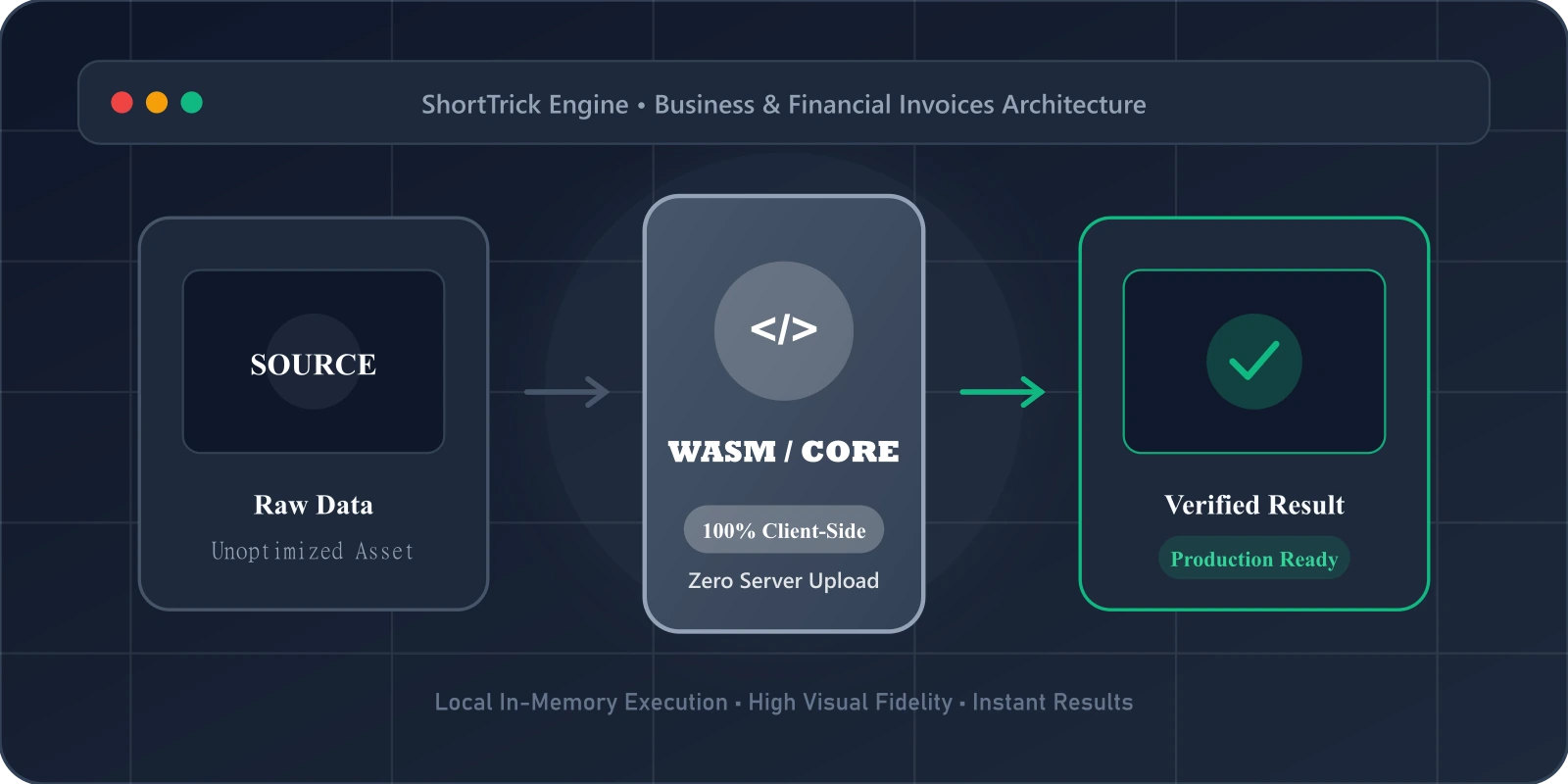
Workflow Lifecycle & Pipeline
Visual execution flow showing how Printable Label Maker processes data directly in your local browser sandbox.
Printable Label Maker Interactive Process Pipeline
Fast, zero-latency execution directly in your browser memory.
Before You Start
Ensure your source assets and browser environment meet the verified execution requirements.
Step-by-Step Instructions
Follow these verified steps to execute the task with Printable Label Maker.
Paste your label text — a blank line between labels
Type or paste into the label text — a blank line between labels box on the page. Printable Label Maker works on what is in it — there is no file to choose.
FRAGILE ⏎ Handle with care ⏎ This way up ⏎ Box 3 of 7Label text — a blank line between labels read as you typeChoose your 16 settings
Label sheet takes one of Avery 5160 / 8160, Avery L7160, Avery 5163 or Custom, Repeat the first label to fill the sheet takes on or off and Font size takes a number from 5 to 48. 13 more sit below. Leave them alone and Printable Label Maker uses Avery 5160 / 8160, off and 10.
Label sheet Avery 5160 / 8160 · Repeat the first label to fill the sheet off · Font size 10Press Make the Sheet
Make the Sheet starts the work in this tab. Nothing is uploaded, so how long it takes is down to your own device.
Make the SheetPrintable Label Maker runs on your deviceDownload the PDF
The result appears with a download button, as PDF. It was made on your device, so nothing has to be cleaned up afterwards.
Under the Hood: In-Browser Algorithmic Computation
Every operation in this utility executes locally in your browser session using high-speed algorithmic transformations. Data inputs are immediately processed in volatile client memory and rendered to screen in sub-millisecond execution cycles.
Immediate Real-Time Computation
Zero server roundtrips guarantee sub-millisecond responsiveness with instant feedback.
Full Data Sovereignty
Your proprietary inputs, calculations, and conversions never travel across public networks.
Offline Capable Execution
Once loaded, the engine works seamlessly even during complete network disconnections.
Settings & Options Explained
Fine-tune quality, format, and compression parameters for your exact workflow.
Settings & Configuration Guide
| Setting | Recommended Value | How It Works & Impact |
|---|---|---|
| Label sheet | Avery 5160 / 8160 | Takes one of Avery 5160 / 8160, Avery L7160, Avery 5163 or Custom. Impact: Each option is a different label sheet; switching it changes the result, not the speed. |
| Repeat the first label to fill the sheet | off | Takes on or off. Impact: Left off, which is what the tool does when you change nothing. |
| Font size | 10 | Takes a number from 5 to 48. Impact: The control runs from 5 to 48; 48 is as far as it goes. |
| Align | Left | Takes one of Left or Centre. Impact: Each option is a different align; switching it changes the result, not the speed. |
| Draw label outlines (for the plain-paper test only) | off | Takes on or off. Impact: Left off, which is what the tool does when you change nothing. |
| Padding inside each label (mm) | 3 | Takes a number from 0 to 20, in steps of 0.5. Impact: The control runs from 0 to 20; 20 is as far as it goes. |
Best Practices & Key Considerations
Avoid common quality pitfalls and maximize output performance.
Expert Recommendations
- Print one page on plain paper and hold it against a sheet of labels in front of a window. This single step catches both failure modes — a wrong template and a printer that feeds differently — and it costs one sheet of ordinary paper.
- Set the print dialog to Actual Size or Scale: 100%. "Fit to page", "shrink to fit" and "scale to printable area" all resize the output, and any of them puts every label out of alignment by a growing amount down the page.
- The measurement that matters on a custom sheet is the pitch, not the label size: the distance from the left edge of one label to the left edge of the next, which is the label width plus the gap. Measure across several labels and divide, because measuring one gap compounds your error.
- Turn label outlines on for the test page and off for the real sheet. On the test they show exactly where each label will land; on a real label a printed border just looks like a mistake.
- Feed label sheets one at a time through the straightest paper path your printer has, and check which way up the sheet goes in. A label sheet that jams is a label sheet with adhesive somewhere inside the printer.
Common Mistakes to Avoid
- Expecting Font size to go past 48 — 5 to 48 is the range the control offers.
- Expecting Padding inside each label (mm) to go past 20 — 0 to 20 is the range the control offers.
- Leaving Label sheet on Avery 5160 / 8160 when Avery L7160 or Avery 5163 was wanted.
- Not noticing that Repeat the first label to fill the sheet starts off.
Troubleshooting & Fixes
Quick solutions for common browser constraints, format issues, and edge cases.
Troubleshooting & Common Issues
Font size will not go above 48
Possible Cause: The control runs from 5 to 48.
Padding inside each label (mm) will not go above 20
Possible Cause: The control runs from 0 to 20.
The answer is right but not in the form you wanted
Possible Cause: Label sheet is set to Avery 5160 / 8160, and it decides that.
Pressing the button does nothing
Possible Cause: Printable Label Maker has nothing to work on until the input is filled.
Frequently Asked Questions
Everything you need to know about formats, privacy, and browser support.
Related Step-by-Step Guides
Explore companion workflows, optimization techniques, and verified tutorials.