Ready to Execute
Click the blue ▶ Run button in the header bar or press Ctrl + Enter to compile and preview your results.
About File Extension Checker — Free Online Tool
File Extension Checker says what an extension means, which content type to serve it with, what magic number a real file of that type begins with, and which other formats share it.
A table of about fifty common extensions cross-referenced against 35 magic-number signatures, with the shared-signature families called out.
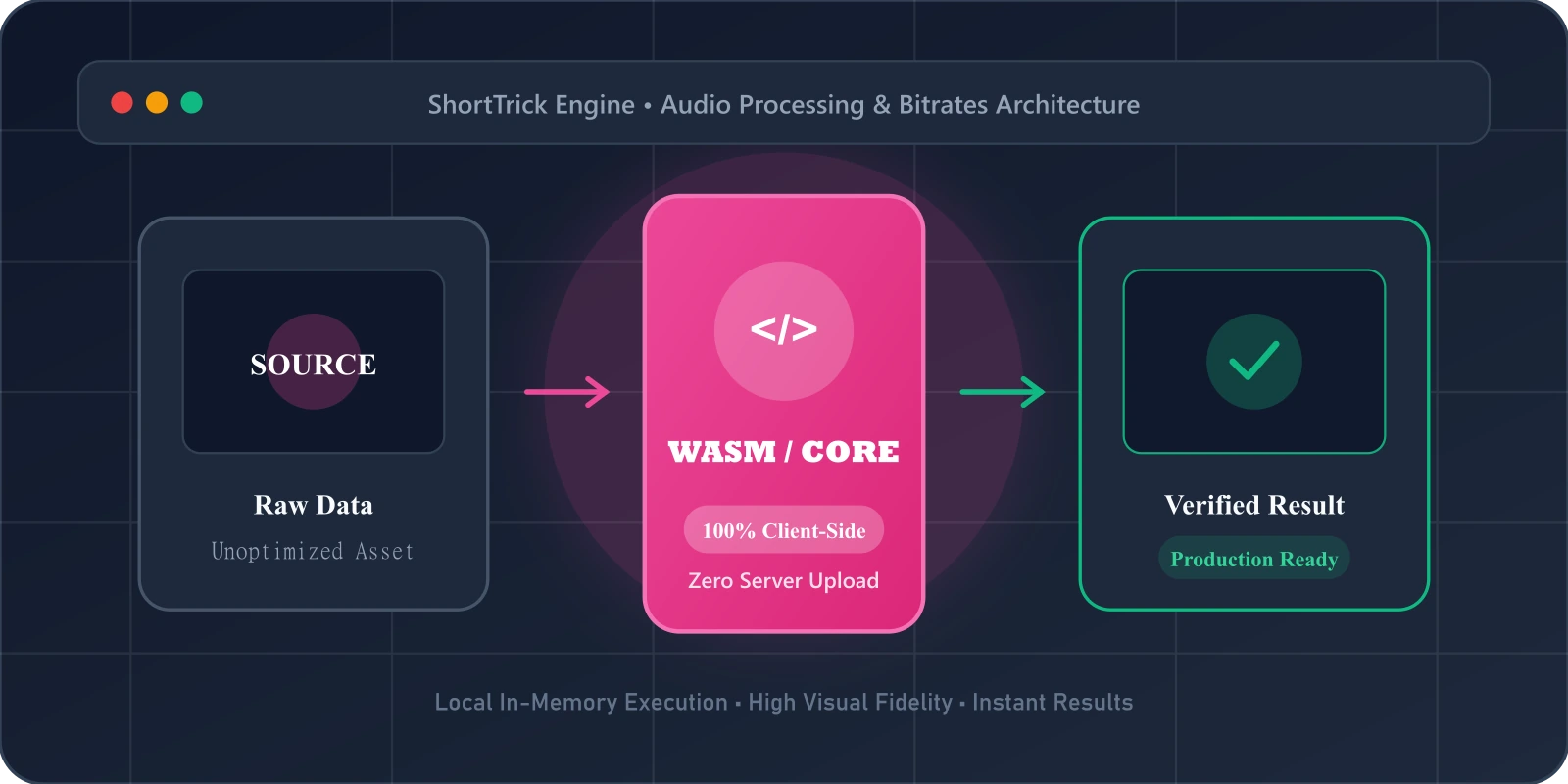
The suffix is matched against a table held locally. The file itself is never read or transmitted.
Finding the right content type for a download, identifying an unfamiliar extension, and understanding why several formats look identical to a type checker.
Also known as: what is this file extension · extension to mime type · file extension lookup
When to use it
Because serving a file with the wrong content type breaks it in ways that look like something else entirely, and because an unfamiliar extension is otherwise a web search away.
How it works
The extension is looked up in a table of common formats and cross-referenced against the magic-number signatures that would confirm it.
An Extension Is A Convention
Nothing in a file records its extension; the name is metadata held by the filesystem. Anyone can invent one, many applications do, and renaming changes nothing about the data. On Windows the extension still decides which program opens a file, which is why hiding known extensions has been a security problem for twenty-five years — "invoice.pdf.exe" displays as "invoice.pdf" with a PDF icon.
The Content Type Is What A Browser Obeys
A browser decides what to do with a download from the Content-Type header, not the filename. Serve a PDF as text/plain and it renders as gibberish in the window; serve a VTT file as text/plain and a <track> element refuses it; serve an unknown type as application/octet-stream and the browser downloads rather than guessing, which is the safe default. The right type for each extension is given here for exactly that.
Shared Signatures, Distinct Meanings
DOCX, XLSX, PPTX, EPUB, JAR, APK and ODT all begin with the same four bytes, because all of them are ZIP archives. The signature identifies the container and the extension identifies the payload, so for this family the extension carries real information that the bytes alone do not. That is also why a type checker reporting "ZIP archive" for your Word document is correct rather than confused.
The Extensions That Are Executable Content
HTML and SVG are the ones to watch when accepting uploads. SVG is XML and can contain scripts; HTML obviously can. Serve either from your own origin and its author gets your origin, with your cookies and your permissions. The standard mitigations are a separate domain for user content, Content-Disposition: attachment, and X-Content-Type-Options: nosniff — and validating the CONTENT rather than the extension, since the extension is the one thing an attacker chooses freely.
How to Use File Extension Checker in 4 Easy Steps
Follow this simple guide to process your files in seconds directly inside your browser tab.
Provide Input for File Extension Checker
Paste your payload, code snippet, or string into the File Extension Checker editor workspace. A lookup for a file extension: what kind of thing it names, the MIME type to serve it with, and how to confirm a file really is one.
Configure Formatting & Validation Rules
Select indentation preferences, minification, encoding options, or validation rules. Because serving a file with the wrong content type breaks it in ways that look like something else entirely, and because an unfamiliar extension is otherwise a web search away.
Run In-Browser Engine
The engine executes File Extension Checker locally in your browser with microsecond latency and zero server transmission.
Copy or Download Output
Copy the sanitized, formatted, or generated output directly to your clipboard or download it for your project.
Why Use File Extension Checker on ShortTrick
Engineered for maximum speed, strict privacy, and frictionless digital productivity.
Zero Code or Token Leaks
Proprietary source code, API keys, database queries, and tokens processed in File Extension Checker never leave your browser.
Microsecond Performance
Optimized AST parsers and Web Crypto APIs process large payloads in File Extension Checker in milliseconds.
Syntax Validation & Formatting
File Extension Checker highlights syntax errors and enforces standard formatting conventions automatically.
Offline Ready
Once loaded, File Extension Checker functions entirely offline without requiring an active internet connection.
Frequently Asked Questions About File Extension Checker
Common questions regarding File Extension Checker, data privacy, file format compatibility, and usage limits.
Popular Searches & Related Tasks for File Extension Checker
Common search phrases, secondary format tasks, and workflows users reach for when using this tool.
Direct Variations & Search Synonyms (8)
Specific Workflows & Long-Tail Queries (15)
Semantic Standards & Technical Entities (20)
Three different claims about what a file is
A file announces its type in three places, and they are allowed to disagree. Only one of them is written by whatever created the file; the other two are claims anybody can change, which is exactly why relying on the convenient one is a standard security mistake.
| Signal | Lives in | Set by | Trustworthy |
|---|---|---|---|
| Extension | The filename | Anyone who renames it | No |
| MIME type | The HTTP header | The server, often guessing | Only as far as the server |
| Magic bytes | The first bytes of the file | The program that wrote it | Largely yes |
| Encoding | The bytes throughout | The program that wrote it | Detected, not declared |
In practice: Renaming a file changes nothing about it, which is why an upload accepted on its extension alone is a hole: the bytes inside decide what actually runs. Encoding is a separate question again, and a mis-detected one is what turns an apostrophe into three strange characters. A server sending the wrong MIME type is its own category of problem, and it is the reason a correct script can refuse to load with no error that mentions the script.
Related Developer Tools Tools & Popular Utilities
Explore complementary browser-based tools with zero file uploads and instant in-memory execution.
More Developer Tools Tools
Popular Tools Across Other Categories
Related Reading & Tutorials
Guides, articles, and best practices for developer tools workflows.