Ready to Execute
Click the blue ▶ Run button in the header bar or press Ctrl + Enter to compile and preview your results.
About File Type Identifier — Free Online Tool
File Type Identifier reads the first bytes of a file and tells you what it actually is, which is frequently not what its extension claims.
Matches the first 512 bytes against 35 magic-number signatures, prints the bytes in hex and ASCII, and reports a mismatch between the content and the extension explicitly.
Only the first 512 bytes are read, in your browser. Nothing is uploaded.
Identifying a file with no extension, confirming a download is what it claims, diagnosing a file an application refuses to open, and checking an upload.
Also known as: magic number checker · what file type is this · identify file without extension · file signature checker
When to use it
Because an extension is a claim and the bytes are evidence, and when they disagree the bytes are what every program will eventually act on.
How it works
The first 512 bytes are read and compared against known signatures. The result is shown alongside the extension and the browser’s own guess.
An Extension Is A Claim, Not A Property
Renaming a file changes nothing about its contents. A .jpg containing PNG data is a PNG; an image viewer will usually open it anyway because it checks the bytes, while a program that trusts the name will fail with a confusing error. That is the common case — the harmful one is an upload form that accepts anything called .jpg, which is why any system accepting files should validate content and never the extension.
Not Everything Has A Magic Number
Text formats mostly do not. CSV, JSON, HTML, SVG, Markdown and source code have no defined header, because they are defined by their content rather than by a prefix. So "no signature found" on a file whose bytes are 95% printable ASCII is not a failure to identify — it is the correct answer, and this tool says so rather than reporting "unknown binary".
One Signature, Many Formats
PK\x03\x04 is a ZIP archive — and a DOCX, an XLSX, a PPTX, an EPUB, a JAR and an APK, because every one of those is a ZIP containing specific files. The signature identifies the CONTAINER; only the extension (or looking inside) identifies what is in it. Rename a .docx to .zip and you can open it and read the XML. For these formats the extension carries real information the bytes do not.
The Browser’s Type Is Not A Second Source
A browser reports a file’s type from the operating system’s extension mapping, not from its contents. So when it says image/jpeg about a file named .jpg, that is the same claim repeated, not independent confirmation. It is shown here for completeness and should not be weighed against the magic number. Only the first 512 bytes are ever read, and they stay in your browser.
How to Use File Type Identifier in 4 Easy Steps
Follow this simple guide to process your files in seconds directly inside your browser tab.
Provide Input for File Type Identifier
Paste your payload, code snippet, or string into the File Type Identifier editor workspace. A reader for the magic number — the handful of bytes a file format is defined to begin with — which identifies a file regardless of what it is called.
Configure Formatting & Validation Rules
Select indentation preferences, minification, encoding options, or validation rules. Because an extension is a claim and the bytes are evidence, and when they disagree the bytes are what every program will eventually act on.
Run In-Browser Engine
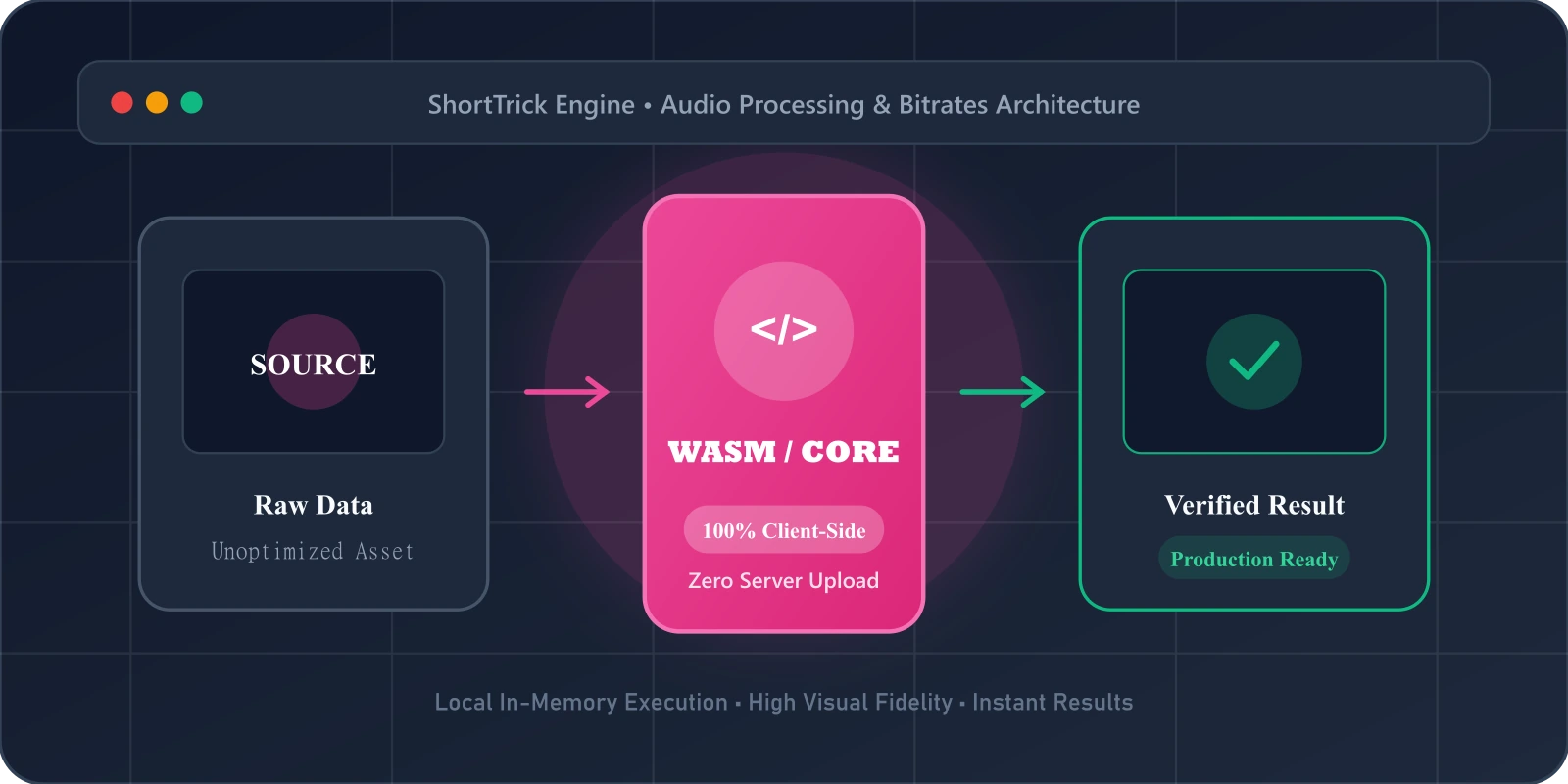
The engine executes File Type Identifier locally in your browser with microsecond latency and zero server transmission.
Copy or Download Output
Copy the sanitized, formatted, or generated output directly to your clipboard or download it for your project.
Why Use File Type Identifier on ShortTrick
Engineered for maximum speed, strict privacy, and frictionless digital productivity.
Zero Code or Token Leaks
Proprietary source code, API keys, database queries, and tokens processed in File Type Identifier never leave your browser.
Microsecond Performance
Optimized AST parsers and Web Crypto APIs process large payloads in File Type Identifier in milliseconds.
Syntax Validation & Formatting
File Type Identifier highlights syntax errors and enforces standard formatting conventions automatically.
Offline Ready
Once loaded, File Type Identifier functions entirely offline without requiring an active internet connection.
Supported Formats & Limits
Designed for high performance with browser-side memory guarantees.
0 MB
1
Frequently Asked Questions About File Type Identifier
Common questions regarding File Type Identifier, data privacy, file format compatibility, and usage limits.
Popular Searches & Related Tasks for File Type Identifier
Common search phrases, secondary format tasks, and workflows users reach for when using this tool.
Direct Variations & Search Synonyms (8)
Specific Workflows & Long-Tail Queries (15)
Semantic Standards & Technical Entities (20)
Three different claims about what a file is
A file announces its type in three places, and they are allowed to disagree. Only one of them is written by whatever created the file; the other two are claims anybody can change, which is exactly why relying on the convenient one is a standard security mistake.
| Signal | Lives in | Set by | Trustworthy |
|---|---|---|---|
| Extension | The filename | Anyone who renames it | No |
| MIME type | The HTTP header | The server, often guessing | Only as far as the server |
| Magic bytes | The first bytes of the file | The program that wrote it | Largely yes |
| Encoding | The bytes throughout | The program that wrote it | Detected, not declared |
In practice: Renaming a file changes nothing about it, which is why an upload accepted on its extension alone is a hole: the bytes inside decide what actually runs. Encoding is a separate question again, and a mis-detected one is what turns an apostrophe into three strange characters. A server sending the wrong MIME type is its own category of problem, and it is the reason a correct script can refuse to load with no error that mentions the script.
Related Developer Tools Tools & Popular Utilities
Explore complementary browser-based tools with zero file uploads and instant in-memory execution.
More Developer Tools Tools
Popular Tools Across Other Categories
Related Reading & Tutorials
Guides, articles, and best practices for developer tools workflows.

How to Identify a File Type (Read the Bytes, Not the Name)
How to Read a HAR File and Find What Made a Page Slow
How to Strip Secrets From a HAR Before You Share It