Ready to Execute
Click the blue ▶ Run button in the header bar or press Ctrl + Enter to compile and preview your results.
About File Merger — Free Online Tool
File Merger joins text files in order, removes repeated CSV header rows, strips byte-order marks at every join — and refuses binary files, because concatenating two MP4s does not produce a video.
Normalises line endings and removes a BOM from each part. When every input is a CSV with a matching header, the repeats are dropped; when the headers differ, it says so instead.
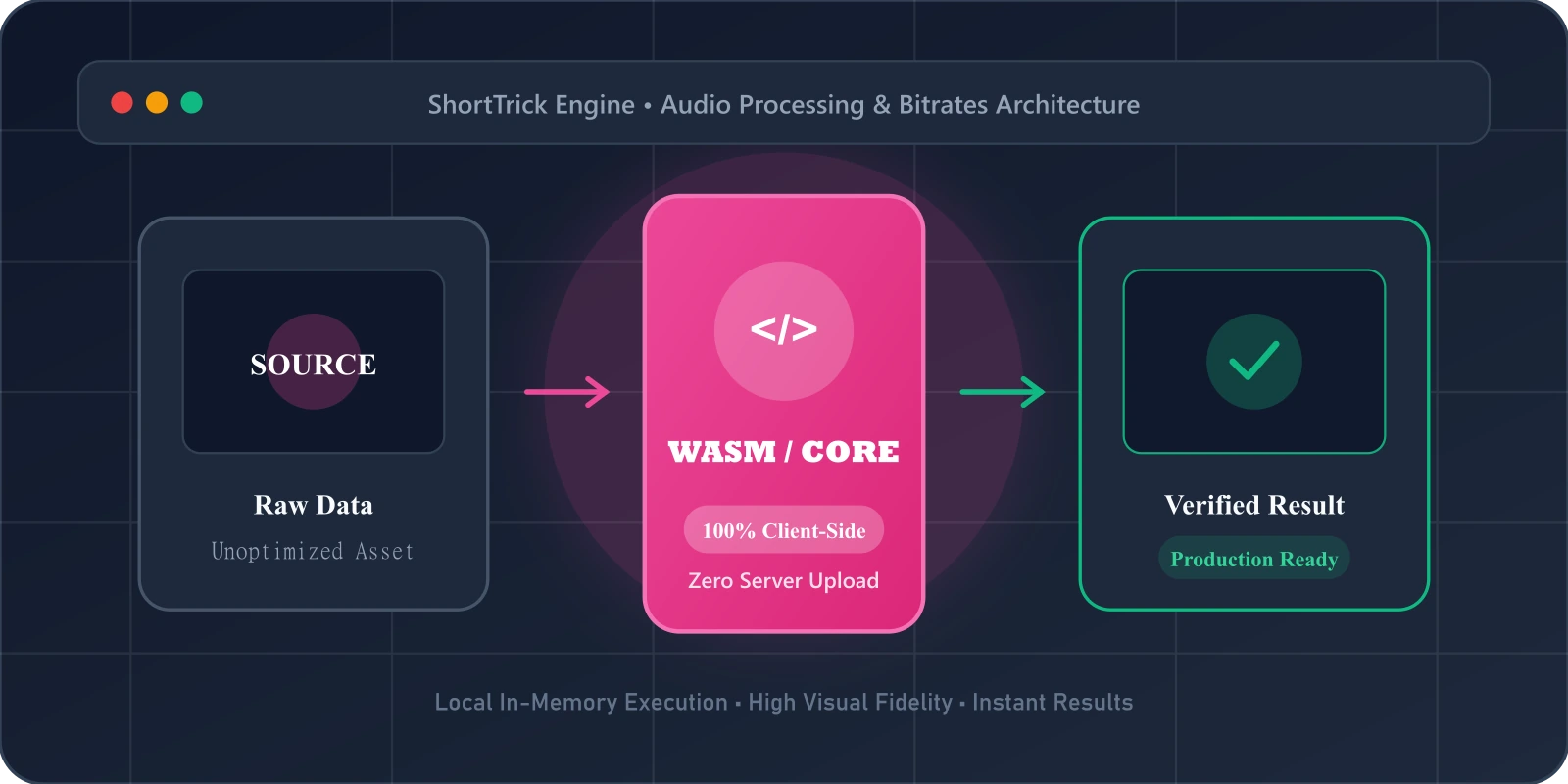
Bytes are concatenated in memory here. No part of any file is transmitted.
Combining split CSV exports, joining log files, merging subtitle or SQL fragments, and consolidating a folder of text.
Also known as: merge text files · combine csv files · concatenate files
When to use it
Because joining CSVs by hand produces a file with the header row buried in the middle, and every tool downstream then treats it as data.
How it works
Each file is decoded, its BOM removed and its line endings normalised. CSV headers are compared and the repeats dropped before the parts are joined.
Why It Refuses Binary Files
Concatenating two MP4s does not produce a longer video. Nor do two PDFs produce a two-document PDF, or two ZIPs a combined archive. Every container format has a header describing the whole file and usually an index at one end, and a second copy of both in the middle invalidates them. The result either fails to open or — worse — opens showing only the first file and looks like it worked. This refuses rather than producing that, and points at the PDF merger and the video joiner, which understand their formats.
The CSV Header Is The Whole Problem
Export a large table and you get part1.csv, part2.csv, part3.csv, each beginning with the same header row. Join them naively and the header appears twice in the middle of the data, where a spreadsheet reads it as a row and a parser either errors or silently imports "id" as an id. This compares the header of each file against the first and drops it when they match — and when they do NOT match, it says so, because different headers mean the files have different columns and merging them produces rows whose fields do not line up.
Byte-Order Marks At Every Join
A BOM is three invisible bytes at the start of a file. Merge ten files that each have one and you get nine invisible characters scattered through the result, each sitting at the start of a line where it will corrupt the first field of a CSV row or break a parser. Every part has its BOM removed here, which is the fix for a merged file that looks correct and imports wrongly.
Order Is Not Guaranteed By The Picker
Files are merged in the order the browser hands them over, which is usually but not reliably the order shown in the file dialog — and is definitely not numeric order, so part10 may land between part1 and part2. The order used is listed in the output. If sequence matters, check that list before using the result, and consider zero-padded filenames in future, which sort correctly everywhere.
How to Use File Merger in 4 Easy Steps
Follow this simple guide to process your files in seconds directly inside your browser tab.
Provide Input for File Merger
Paste your payload, code snippet, or string into the File Merger editor workspace. A merger for text files that handles the three things a naive concatenation gets wrong: the repeated CSV header, byte-order marks, and mixed line endings.
Configure Formatting & Validation Rules
Select indentation preferences, minification, encoding options, or validation rules. Because joining CSVs by hand produces a file with the header row buried in the middle, and every tool downstream then treats it as data.
Run In-Browser Engine
The engine executes File Merger locally in your browser with microsecond latency and zero server transmission.
Copy or Download Output
Copy the sanitized, formatted, or generated output directly to your clipboard or download it for your project.
Why Use File Merger on ShortTrick
Engineered for maximum speed, strict privacy, and frictionless digital productivity.
Zero Code or Token Leaks
Proprietary source code, API keys, database queries, and tokens processed in File Merger never leave your browser.
Microsecond Performance
Optimized AST parsers and Web Crypto APIs process large payloads in File Merger in milliseconds.
Syntax Validation & Formatting
File Merger highlights syntax errors and enforces standard formatting conventions automatically.
Offline Ready
Once loaded, File Merger functions entirely offline without requiring an active internet connection.
Supported Formats & Limits
Designed for high performance with browser-side memory guarantees.
0 MB
50
Frequently Asked Questions About File Merger
Common questions regarding File Merger, data privacy, file format compatibility, and usage limits.
Popular Searches & Related Tasks for File Merger
Common search phrases, secondary format tasks, and workflows users reach for when using this tool.
Direct Variations & Search Synonyms (8)
Specific Workflows & Long-Tail Queries (15)
Semantic Standards & Technical Entities (20)
ZIP, TAR, 7z and RAR
Two separate jobs hide inside the word "archive": putting many files into one, and making that one file smaller. ZIP does both at once, TAR only does the first, and that single difference explains most of what follows.
| ZIP | TAR | TAR.GZ | 7z | RAR | |
|---|---|---|---|---|---|
| Bundles files | Yes | Yes | Yes | Yes | Yes |
| Compresses | Yes | No | Yes | Yes, best ratio | Yes |
| Extract one file fast | Yes | Yes | No | Yes | Yes |
| Keeps Unix permissions | Partly | Yes | Yes | Partly | Partly |
| Opens with no extra software | Yes | Mac and Linux | Mac and Linux | No | No |
| Free to create | Yes | Yes | Yes | Yes | No |
In practice: ZIP when anyone else has to open it, because every operating system opens it without installing anything. TAR.GZ compresses the whole bundle as one stream, which is why it is smaller than ZIP and why pulling a single file out of it means reading through everything before it. RAR is the odd one: extracting is free, creating one needs licensed software.
Related Developer Tools Tools & Popular Utilities
Explore complementary browser-based tools with zero file uploads and instant in-memory execution.
More Developer Tools Tools
Popular Tools Across Other Categories
Related Reading & Tutorials
Guides, articles, and best practices for developer tools workflows.